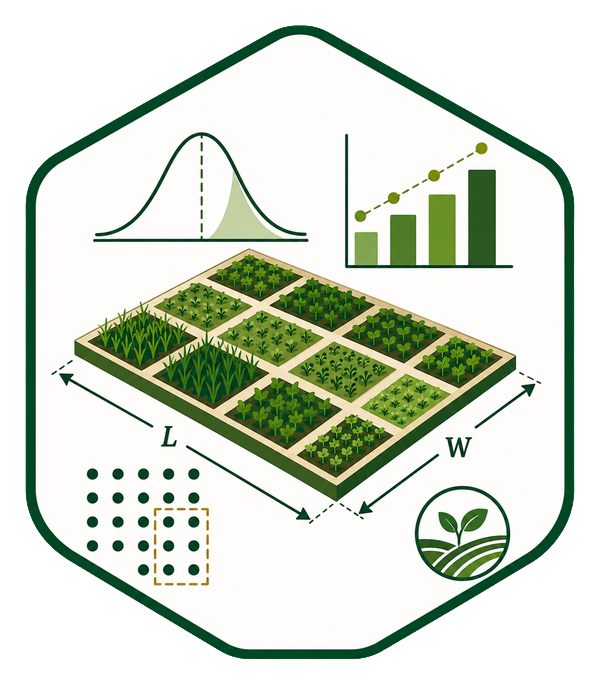
A simulated uniformity trial used throughout the package examples and vignettes. A uniformity trial is a field sown uniformly – one genotype, one management – and harvested in a fine grid of small basic experimental units (BEU). The spatial variation that remains is environmental noise, and it is what plot-size methods use to decide how large a plot must be.
Format
A data frame with 24 rows (8 grid rows \(\times\) 3 trials) and 14 variables:
- trial
trial identifier,
"T1","T2"or"T3".- row
grid row index, 1-8.
- col01
response (g m\(^{-2}\)) at grid column 1.
- col02
response (g m\(^{-2}\)) at grid column 2.
- col03
response (g m\(^{-2}\)) at grid column 3.
- col04
response (g m\(^{-2}\)) at grid column 4.
- col05
response (g m\(^{-2}\)) at grid column 5.
- col06
response (g m\(^{-2}\)) at grid column 6.
- col07
response (g m\(^{-2}\)) at grid column 7.
- col08
response (g m\(^{-2}\)) at grid column 8.
- col09
response (g m\(^{-2}\)) at grid column 9.
- col10
response (g m\(^{-2}\)) at grid column 10.
- col11
response (g m\(^{-2}\)) at grid column 11.
- col12
response (g m\(^{-2}\)) at grid column 12.
To recover a trial as a numeric matrix (the form the grid functions expect):
Details
The data are entirely synthetic (a separable first-order autoregressive
field plus independent noise), so they carry no usage restriction. Three
independent trials are provided, each an 8 (rows) by 12 (columns) grid of
1 m\(^2\) BEU whose response is a biomass-like measurement in
g m\(^{-2}\). The parameters were chosen so the coefficient of variation
falls with plot size and levels off at a plateau, as in a real trial. The
generating script is in data-raw/uniformity_trial.R.